Wednesday, July 20, 2011

Do you have the heart for foreign exchange trading?

Do you have the heart for foreign exchange trading?


When he isn’t working as a Sacramento-area chiropractor, Neil Kalia likes to watch the currencies of other countries closely. Very closely.

Kalia, 34, estimates that he spends between 40 and 50 hours a week boning up on how the Euro, Australian dollar and British pound stack up against the U.S. dollar. When he trades, it’s usually quick: “anywhere between 24 hours to two weeks, I get out.”

Statistics confirm tremendous growth in foreign exchange trading by individuals such as Kalia in the past decade. According to the Bank of International Settlements (BIS), daily volume of foreign exchange trading has nearly quadrupled since 2001, from $1.2 trillion in 2001 to just below $4 trillion today. “That’s more than all the stock market volume combined on a daily basis, and that goes back to how liquid the currency market is,” says Brian Dolan, the chief currency strategist at FOREX.com and the co-author of “Currency Trading for Dummies.”

But it’s much more debatable to what extent currency belongs in the average investor’s portfolio, how trades should transpire — and who should execute them. Insiders stress that mapping the peaks and valleys of pounds and dollars is not for hobbyists, but well-equipped pros.

“The average investor should not speculate in currency, in much the same way I would say the average person should avoid going to Vegas,” says Steve Horan, head of Private Wealth at CFA Institute, and co-author of “The Forbes/CFA Institute Investment Course.” “There are a lot of smart people playing the currency market; they’ve got more tools, more data and more training — and I don’t want to play against them.”

more story...

Sunday, July 17, 2011

Gold hits record high on U.S.,

Gold hits record high on U.S., Europe debt worries

SINGAPORE | Sun Jul 17, 2011 10:41pm EDT

SINGAPORE (Reuters) - Spot gold touched a record high on Monday, reflecting persistent worries about the euro zone debt crisis and a growing threat of a U.S. government default.

Spot gold rose to an all-time peak of $1,598.41 and U.S. gold hit a record high of $1,599.20.

The appetite for bullion as a safe storage of value increased, as investors feared that the stalemate in negotiations over U.S. deficit plan could lead to a default, which might wreak havoc in global markets and send the world's top economy back to recession.

Adding to worries about the economic growth, U.S. consumer confidence hit a near 2-1/2-year low in early July and manufacturing output stalled in June.

"The political uncertainties in the United States and Europe will be an ongoing theme and safe-haven demand will continue," said Natalie Robertson, a commodities analyst at ANZ. more story...

Friday, July 15, 2011

Consumer Sentiment in U.S. Falls to 2-Year Low

Consumer Sentiment in U.S. Falls to 2-Year Low

Confidence among U.S. consumers unexpectedly fell in July to the lowest level in more than two years, adding to concern that weak employment gains and falling home prices may keep households from spending.

The Thomson Reuters/University of Michigan preliminary index of consumer sentiment decreased to 63.8, the weakest reading since March 2009, from 71.5 the prior month. The gauge was projected to rise to 72.2, according to the median forecast of 62 economists surveyed by Bloomberg News.

Slow jobs gains and falling home values may be weakening Americans’ outlooks, underscoring Federal Reserve Chairman Ben S. Bernanke comments to Congress earlier this week. At the same time, gas prices still north of $3.50 may also be weighing on consumers, posing a risk that spending will cool.

“Consumers are still concerned about the economy and the primary driver of that is the sluggish labor market,” said Ryan Wang an economist at HSBC Securities USA Inc. in New York said before the report. “ The relatively low level of sentiment is in fact consistent with the modest growth of retail spending that we’ve seen, particularly in the last three months, and that pattern is likely to hold.” more story...

What if the U.S. Fails to Reach Debt Limit Deal?

What if the U.S. Fails to Reach Debt Limit Deal?


Most analysts believe U.S. lawmakers will ultimately arrive at an agreement to lift the $14.3 trillion debt limit in time to avoid defaulting on upcoming interest and debt payments. And just in case the two sides need a little encouragement or reminder of the potential consequences should they fail to arrive at a deal, Moody’s Investors Services and Standard & Poor’s have both served notice that the U.S. is under credit review pending the outcome of the discussions.

The warnings come as representatives from both the Democrats and the Republicans continue to hammer out an agreement to pave the way for the government to borrow beyond the existing debt limit. The Treasury Department has named August 2nd as the deadline, warning that failing to act before this date will leave the country without sufficient funds to meet upcoming debt obligations. After this date, the government will effectively be broke and have no option but to default.

On Wednesday, Federal Reserve Chairman Ben Bernanke used part of his appearance before the Senate Banking Committee to encourage federal lawmakers to get a deal done before the Treasury Department’s cut-off date. Bernanke told the committee that should the Treasury default, the action would send “shockwaves” throughout the global economy.

But what if a deal is not made in time? What would Bernanke’s “shockwaves” look like?

For starters, America’s credit rating would immediately be downgraded to reflect the new “default” status. The government would still have to borrow to cover its operational deficit but with the loss of it’s triple-A rating, borrowing costs would increase dramatically – assuming historical lenders including China, Japan, and Britain would still be willing to bankroll the country. The alternative would be a combination of steep tax hikes and deep spending cuts to cover the shortfall. Full story..

Thursday, July 14, 2011

Italy expected to pass crucial bond auction test

Italy expected to pass crucial bond auction test

(Reuters) - Italy is expected to succeed in selling bonds on Thursday in a crucial test of its ability to continue funding itself from the markets. But a smooth sale would not remove longer-term worries over its financial health. more....

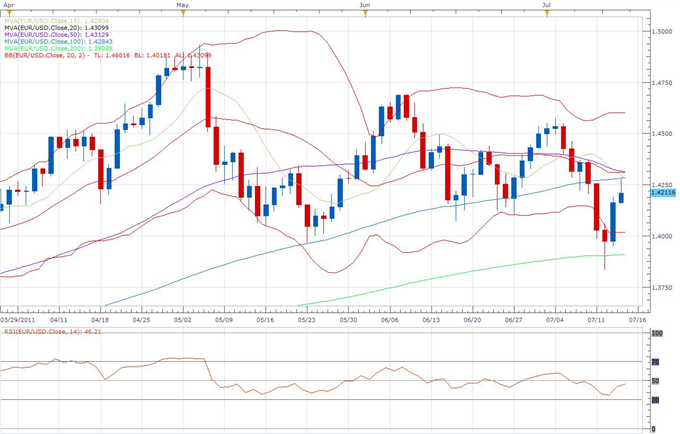
EUR/USD Classical Technical Report 07.14


EUR/USD Classical Technical Report 07.14

By Joel Kruger , Dailyfx

EUR/USD: Overall, price action remains quite bearish and we continue to like the idea of selling into rallies in anticipation of a more sizeable pullback below the 200-Day SMA. The longer-term moving average resides by the 1.3900 figure and a clear break below will open the door for a test of next key support in the 1.3750. In the interim, look for the formation of a fresh lower top somewhere ahead of 1.4400 ahead of the next drop.

Obama and lawmakers face fresh doubts on debt deal


Obama and lawmakers face fresh doubts on debt deal


(Reuters) - Sharply divided by partisan bickering, President Barack Obama and top Republicans face growing doubts on Thursday about the prospects for reaching a deal to avoid a potentially disastrous debt default. more...